
Links to Selected Products
- Labels
- Proteins & Conjugates
- Probes
- Dyes for Imaging
- Dyes for Click Chemistry
- Dyes for 2-Photon Microscopy
- Dyes for Single Molecule Applications
- Dyes for Immunofluorescence
- Dyes for Proteomics
- Dyes for Flow Cytometry
- Dyes for Fluorescence Polarization Assays
- Dyes for FRET Based Assays
- More Products
- More Applications
Applications
- Albumin Determination
- Cholesterol & Triglycerides Measurement
- Click Chemistry
- DNA and Protein Microarrays
- FCS
- Flow Cytometry
- Fluorescence Imaging
- Fluorescence Lifetime (FLT)
- Fluorescence Polarization
- FRET
- Genomics
- Immunofluorescence
- 2-Photon Microscopy
- pH Sensing Applications
- Plasmonics
- Proteomics
- Single Molecule Applications
- Superresolution Microscopy
- Viscosity Measurements
-
Urbana, IL, Sept 2023SETA BioMedicals is currently collaborating with the Micron School of Materials Science & Engineering at Boise State University on phase 3 of a DOE funded project to develop new fluorescent dyes for DNA-controlled dye aggregation as a path to create quantum entanglement.
-
Urbana, IL, Sept 2021SETA BioMedicals and the Micron School of Materials Science & Engineering at Boise State University are currently collaborating on a DOE funded project.
-
Urbana, IL, June 2019SETA BioMedicals will exhibit at the MAF meeting in La Jolla, CA, USA on Aug 20 - 24, 2019! Please visit us at booth 9 to get information about our latest products.
- More>>
-
SETA BioMedicals offers free consultation on the use of SETA products for your application.
Please call us at 217 417 2160.

Welcome to SETA BioMedicals
SETA BioMedicals produces, commercializes and licenses proprietary fluorescent detection reagents (fluorescent dyes, probes, labels, tandems, and standards) for biomedical research applications.
These detection reagents can be ordered over the phone at (217) 417 2160, via e-mail at orders@setabiomedicals.com or with our online shopping cart and are delivered the next day in the continental USA and within days at any other destination around the world.

_709x200_cc5.jpg)
-
Highly Bright, Water-Soluble Rotaxane Labels
Novel, extremely bright and photostable probes and labels based on squaraine rotaxanes. These unique fluorescent reporters combine all desirable features of common fluorophores including high chemical and photochemical stability.
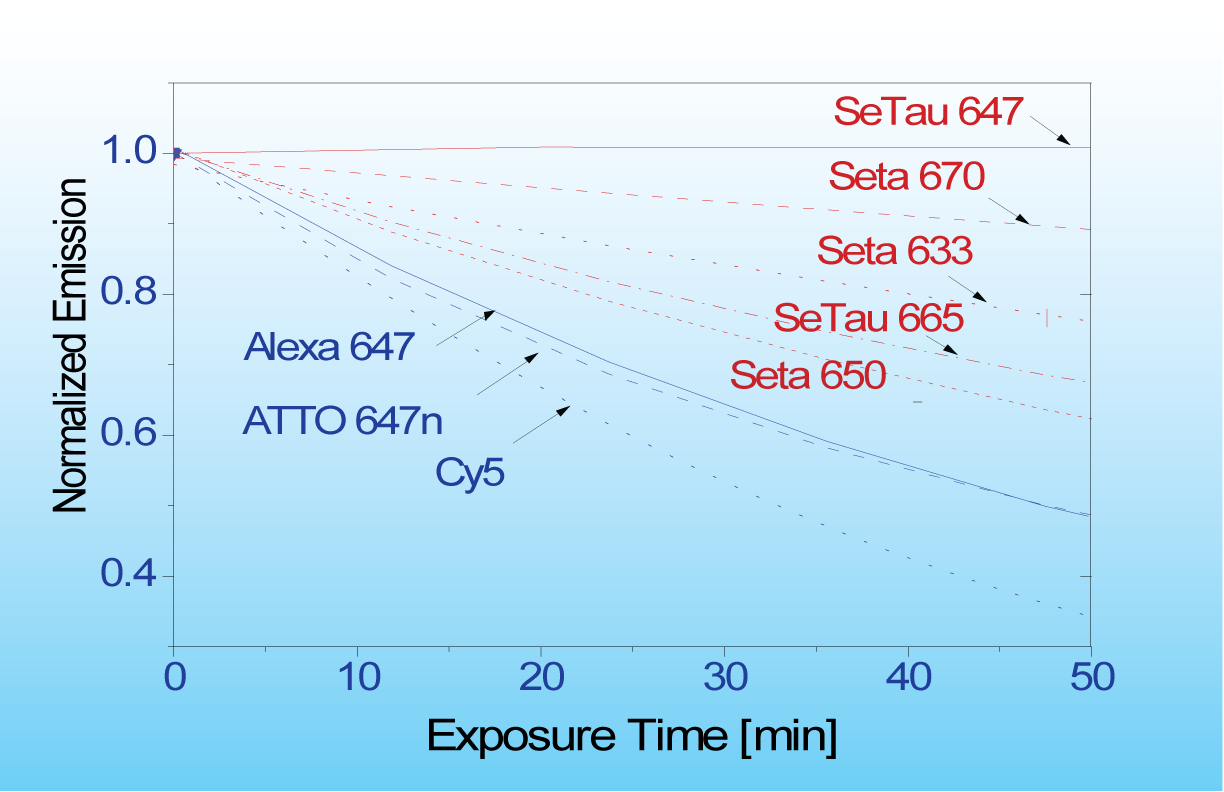
Photostability comparison of several red emitting dyes
-
Phycobiliprotein Tandem Conjugates
Bright and photostable tandem-conjugates of APC, PE and PerCP with Seta dyes for flow cytometry and immuno-fluorescence applications.
.png "\"CD38-APC-Seta-750(296x206).png\"")
Flow cytometry measurment of blood cells stained with CD3 – Seta-APC-780
-
Labeling Technologies
Next generation labels for proteins, oligonucleotides and other biomolecules with exceptional brightness and photostability.
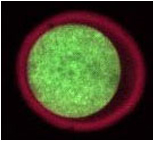
Mouse egg cell stained with
Square-655 and Square-460Mouse egg cell stained with
Square-670-Carboxy -
Click Chemistry Reagents
Azides and proprietary DBCO derivatives of long-lifetime and 2P-imaging dyes with 2PACS of several thousand GM for Cu-catalyzed and Cu-free click chemistry reactions
-
Viscosity-Sensitive Probes and Labels
Large Stokes' shift fluorescent molecular rotors with high sensitivity and a large dynamic range in lifetime and intensity mode
-
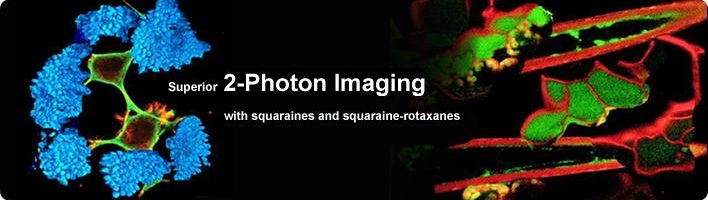
Exeptional Dyes for 2-Photon Microscopy
Fluorescent probes and labels with exceptionally high 2-photon cross sections close to 10,000 GM based on squaraines and squaraine rotaxanes
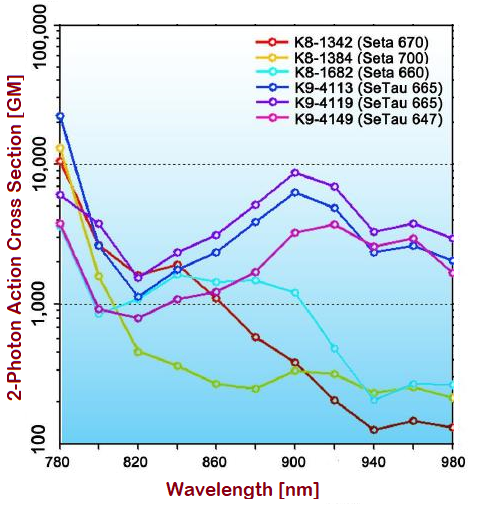 2-PCS comparison of red emitting Seta and SeTau dyes
 -
Fluorescence Lifetime Labels
Fluorescence lifetime labels with lifetimes from 0.5 to 32 ns for fluorescence lifetime and polarization applications
-
Fluorescence Standards
Fluorescence standards are utilized in the calibration and validation of fluorescence instruments, luminescence readers, and as fluorescence reference materials. The standard kits offered by SETA are ready and easy to use!
-
Single Molecule Applications
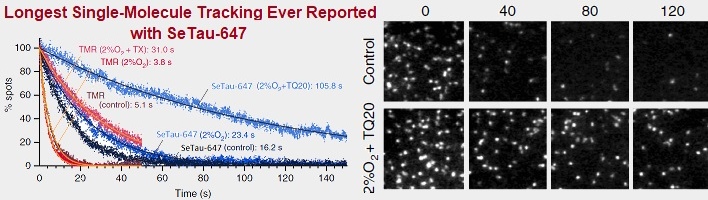
In a comparative study of 13 dyes in Nature Chem. Biol., SeTau-647 (K9-4149 and K9-4148), a squaraine rotaxane dye, exhibited the best photobleaching performance in a single molecule application with an exponential lifetime of 105.8 ns (twice as long as the 2nd best dye Atto-647N).
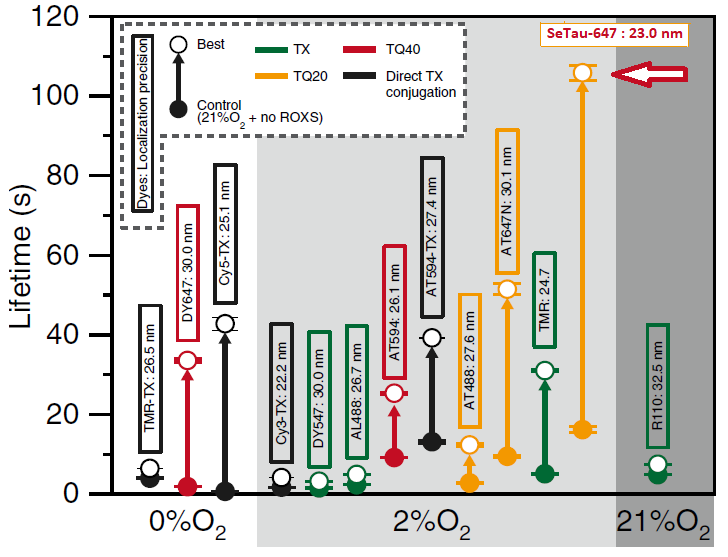
Single molecule study of 13 fluorescent imaging dyes
-
Fluorescence Imaging
Squaraine rotaxane dye SeTau-647 outperforms Alexa dyes (Alexa 488, Alexa 568) in signal-to-background ratio and in vivo imaging properties.
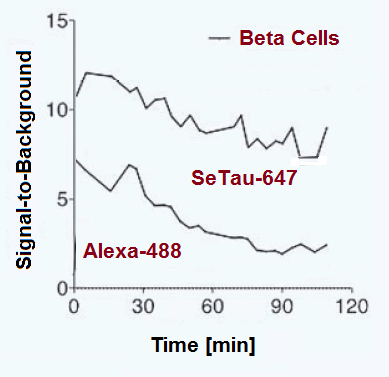
Signal-to-background for SeTau-647 and Alexa 488 in imaging applications
-
2-Photon Microscopy
Compared to conventional cyanine dyes, squaraine and squaraine-rotaxanes exhibit 10 – 50-times higher 2-photon cross-sections in the order of several thousand GM.
.jpg "\"2p-microscopy-neuron(249x249).jpg\"")
Z-projection of a neuron filled with a squaraine rotaxane-labeled peptide
-
Superresolution Microscopy
Seta and SeTau dyes are a class of extremely bright and photostable dyes for fluorescence imaging and are also well suited for STED and STORM applications.
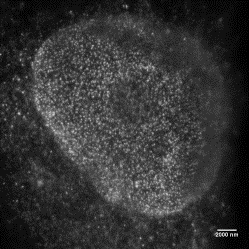
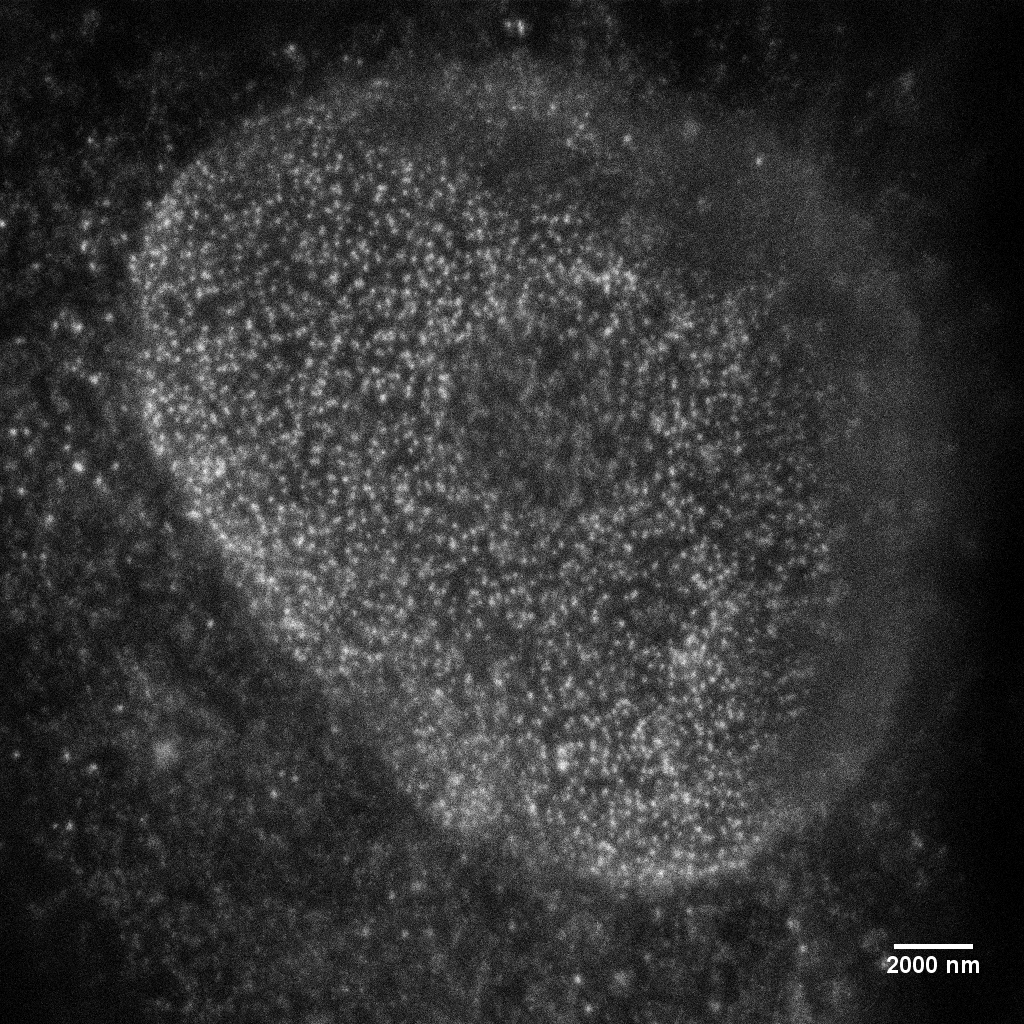
STED image of HeLa-M cell nuclei labeled with primary mAB414 antibody and a secondary antibody labeled with SeTau-647 -
DNA and Protein Microarrays
Our highly fluorescent squaraine rotaxanes exhibit high chemical stability in particular against oxidative reagents such as peroxides or ozone and therefore are excellent detection reagents for DNA and protein microarrays where the fluorescence signals of cyanine dyes such as Cy5 and Alexa 647 are strongly dependent on the concentration of ozone during post-hybridization array washing.